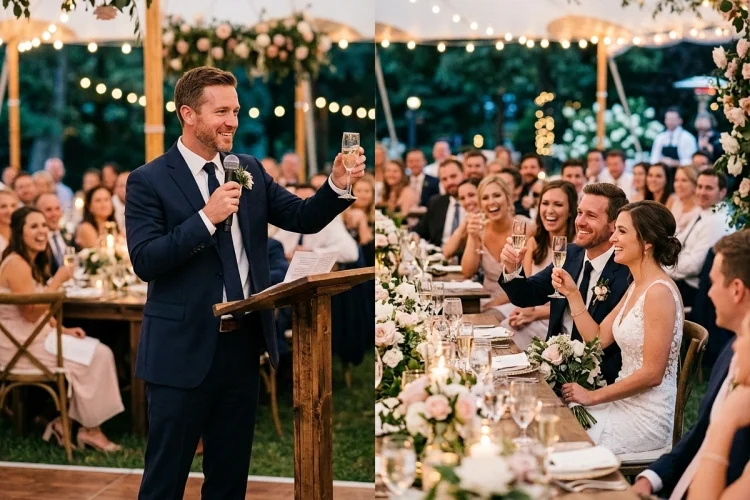
Few speaking situations combine happiness and nervousness quite like a wedding speech. You’re surrounded by family and friends, emotions are already running high, and everyone suddenly turns toward you when someone hands you the microphone.
No pressure, right?
The good news is that a memorable wedding speech doesn’t require professional comedy skills or poetic language. What matters most is sincerity, a clear structure, one or two meaningful stories, and a genuine focus on the couple.
Learning how to write and deliver a wedding speech becomes much easier when you stop trying to create the funniest or most emotional speech anyone has ever heard.
Your job is simply to celebrate two people and help the room appreciate something meaningful about their relationship.
Toastmasters recommends keeping wedding toasts personal, focused on the couple, carefully prepared, and relatively brief. Emily Post similarly advises writing and practicing a toast ahead of time while keeping the spotlight on the people being honored.
Here’s how to turn those principles into a speech that feels warm, natural, and memorable.
Start by Deciding What Your Speech Is Really About
Before writing jokes or searching for romantic quotes, decide what you want people to remember.
Your speech needs a central idea.
Perhaps you’ve watched your best friend become happier and more confident since meeting their partner. Maybe the couple supports each other during difficult moments. Or perhaps what stands out is how naturally they make ordinary life enjoyable.
Your theme might be as simple as:
“They make each other better.”
Or:
“Their relationship proves that love often appears in the little things.”
Once you have a theme, every story and joke has a purpose.
Without one, wedding speeches often become a collection of unrelated memories:
“We went to college together. Then we took a trip to Spain. Then there was this funny thing at a restaurant…”
Interesting stories aren’t automatically a good speech.
Choose memories that reveal something meaningful about the person or couple.
Use a Simple Wedding Speech Structure
You don’t need a complicated formula. A basic structure works perfectly well:
Introduction → Personal connection → Story → Couple → Well wishes → Toast
Toastmasters specifically recommends giving a wedding toast an opening, body, and conclusion rather than simply improvising.
1. Introduce Yourself Briefly
If many guests don’t know you, explain who you are.
For example:
“For anyone I haven’t met, I’m Daniel, and I’ve had the privilege of being Mark’s best friend since university.”
That’s enough.
You don’t need your biography.
2. Move Into a Meaningful Story
Choose one strong memory rather than five average ones.
Maybe you remember the first time your friend talked about their future spouse or a small moment when you realized how well the couple worked together.
Then connect the story to your central message.
3. Bring the Focus to Both Partners
Even if you know one person much better, remember that you’re celebrating a marriage.
The speech should gradually move from “my friendship with Alex” toward “Alex and Sam together.”
Finish by expressing your hopes for their future and inviting everyone to raise a glass.
Tell One Good Story Instead of Listing Memories
Stories are often the strongest part of a wedding speech because they allow guests to see something about the couple rather than simply hearing compliments.
Instead of:
“James is incredibly loyal.”
Tell the audience when you saw that loyalty.
For example:
“Years ago, my car broke down two hours away from home. James had work early the next morning, but he still drove out at midnight to get me. That’s James. If someone he loves needs him, he shows up.”
Then connect that quality to the marriage:
“And watching him with Emma, I’ve seen that same loyalty become something even stronger.”
Toastmasters’ storytelling guidance recommends choosing stories that clearly support your message and trimming them when they become long enough to distract from the larger speech.
You don’t need every detail.
Set the scene, explain what happened, and show why it matters.
Use Humor Without Embarrassing the Couple
Humor works beautifully in wedding speeches when it feels affectionate.
The safest jokes usually come from shared habits, harmless personality quirks, or situations where the person you’re teasing can laugh too.
For example:
“When Michael told me he’d finally learned to cook, I was impressed. Then I discovered his definition of cooking was moving frozen pizza from the freezer to the oven.”
Light teasing works because nobody gets hurt.
Avoid jokes about former relationships, private sexual details, serious family conflicts, humiliating incidents, or anything the couple would prefer not to have shared with grandparents, coworkers, and children in the room.
Toastmasters recommends using humor while avoiding embarrassing stories and offensive language, while The Knot similarly advises keeping wedding humor lighthearted, warm, and respectful rather than humiliating the couple.
A useful test is:
“Would I still tell this story if the couple’s parents were standing beside me?”
At a wedding, they probably are.
Make Sure the Speech Celebrates Both People
One common best-man or maid-of-honor mistake is spending 90% of the speech talking about their friend.
Then, near the end:
“And Sarah seems great too.”
Remember what everyone is celebrating.
If you’ve known one partner for 15 years and the other for only two, your perspective will naturally be different. That’s fine.
Use your relationship with your friend as the starting point, then explain what you’ve noticed since their partner entered their life.
For example:
“I’ve known Rachel since we were twelve, and I’ve seen her happy many times. But the happiness she has with Ben feels different. It’s calmer. She doesn’t just laugh with him—she seems completely comfortable being herself.”
Now you’re honoring their relationship rather than delivering a biography of one person.
Wedding guidance consistently recommends keeping the couple at the center of the speech rather than making the moment primarily about the speaker.
Keep Your Wedding Speech Short
Wedding guests may love you, but they probably don’t want a 20-minute documentary about your friendship.
Keep things focused.
Toastmasters suggests roughly two to three minutes for many social toasts, while The Knot’s wedding experts commonly recommend keeping a fuller wedding speech around three to five minutes.
That is enough time for a meaningful introduction, one good story, a few sincere observations, and a strong ending.
Read your draft aloud with a timer.
If you’re significantly over five minutes, look for repeated ideas.
You may discover that three stories demonstrate exactly the same personality trait. Keep the strongest one.
Shortening a wedding speech doesn’t make it less meaningful.
Often, removing unnecessary material makes the emotional moments stronger.
End With Something Sincere
Your ending doesn’t need to be clever.
It needs to feel true.
After the jokes and stories, slow down and speak directly to the couple.
You might say:
“Laura and David, I hope you always keep making each other laugh the way you do today, especially when life gives you fewer reasons to laugh.”
Or:
“I’ve watched you build a relationship filled with friendship, patience, and a lot of laughter. I can’t wait to see the life you build from here.”
Then transition naturally into the toast:
“So please raise your glasses—to Laura and David, and to a lifetime of adventures together.”
Emily Post advises keeping a toast focused on the people being honored and finishing by inviting the room to join in the celebration.
Don’t keep talking after your strongest ending.
Raise the glass, smile, and let the moment belong to the couple.
Practice Out Loud Before the Wedding
Writing the speech is only half the job.
Read it aloud several times.
A sentence that looks beautiful on paper may sound strangely formal when spoken. Rehearsal helps you identify awkward phrases, improve your timing, and become comfortable enough to look away from your notes.
Toastmasters recommends practicing wedding speeches in advance, while Emily Post specifically advises writing the toast beforehand and rehearsing it rather than relying entirely on improvisation.
You do not have to memorize everything.
Note cards are perfectly acceptable.
Print or write your notes clearly enough that you don’t have to squint at them. Know the opening and ending especially well so you can deliver those sections with stronger eye contact.
Also practice holding whatever you’ll actually use-a microphone, note cards, and perhaps a glass.
The wedding day should not be the first time you attempt all three simultaneously.
Deliver the Speech Slowly and Naturally
When the moment arrives, stand comfortably and take a second before beginning.
Look around the room.
Smile.
Then speak.
Nervous speakers often rush, especially at the beginning. Deliberately slow your first few sentences and pause after a joke so people have time to laugh.
Look toward the couple during personal moments instead of staring continuously at your notes.
If you become emotional, pause.
Nobody at a wedding expects you to behave like a television presenter. Emotion usually makes the moment feel more genuine.
And one practical point: don’t rely on alcohol for confidence. Toastmasters advises wedding speakers to remain clear-headed before giving a toast.
The audience isn’t looking for perfection.
They’re looking for sincerity.
Learning how to write and deliver a wedding speech becomes much easier when you remember what the moment is really about: celebrating the couple.
Choose one central idea, build the speech around a meaningful story, use humor carefully, and make sure both partners become part of the message.
Keep the speech relatively short, finish with sincere wishes, and practice enough that you can occasionally look away from your notes and connect with the room.
Most importantly, don’t try to impress everyone.
Try to say something the couple will be happy they heard.
Before the wedding, write your first draft, read it aloud with a timer, and remove anything that doesn’t strengthen the story or celebration. A simple, heartfelt speech delivered sincerely will almost always beat a complicated one trying too hard to be unforgettable.